Use this calculator to calculate the monthly lease payments for a motor vehicle. Compare various car leasing interest rates, loan terms and residual/balloon payments.
Calculator results are estimates based on the inputs and assumptions used and are for general information only. They are not quotes, offers, approvals, eligibility decisions or personalised recommendations, and do not indicate that a lender will provide credit.
Car Lease Details:
Important!
Car Lease Interest Rates differ from lender to lender and will depend on your individual circumstances (credit history, employment status, age, etc.).
Car Lease Amortisation Calculator
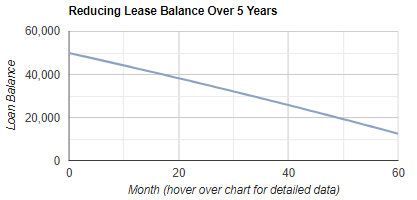
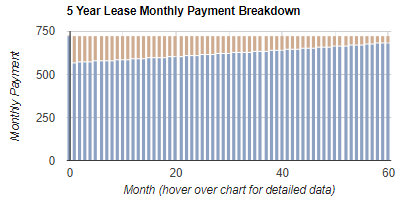
The following amortisation graphs detail month-by-month data on the progress of the proposed loan. The first chart below examines the reducing loan balance over the course of the finance contract term. The second graph illustrates the portion of each monthly repayment allocated to payment of interest vs principal reduction.
How to use our Vehicle Lease Repayment Calculator
Our Vehicle Lease Repayment Calculator helps you estimate monthly lease repayments for a motor vehicle by modelling three key variables: interest rate, lease term, and the residual or balloon amount payable at the end. It’s important because small changes to any of these inputs can materially affect cash flow, total interest over the term, and the end-of-lease obligation, helping you compare scenarios before you speak with a lender or novated leasing provider.
How to complete the form for the best result:
1. Purchase Price
Enter the total amount you want financed for the vehicle. Include relevant upfront costs you intend to roll into the lease (for example, on-road costs or insurance where applicable). Use whole numbers only (no decimals, commas, or dots).
2. Balloon or Residual Value (percent of purchase price)
Select the residual percentage. A higher residual generally reduces the monthly payment but increases the amount left owing at the end, which can increase overall cost across the term. Choose a residual that matches your intended end-of-lease plan (keep, refinance, or sell).
3. Term of Loan (years)
Choose the number of years. Longer terms usually reduce monthly repayments but can increase total interest paid. Select a term that suits how long you expect to keep the vehicle and your budget tolerance.
4. Interest Rate (per annum)
Select an interest rate to simulate. Use a conservative rate when stress-testing affordability, because your actual rate may differ depending on lender policy and your circumstances.
5. Calculate
Click calculate to generate your estimated monthly lease repayment and amortisation visuals.
How to interpret the results:
1. Monthly repayment estimate: Use this as a budgeting guide and compare scenarios by adjusting term, rate, and residual.
2. Amortisation charts: Review how the balance reduces over time and how much of each payment is interest versus principal; this highlights when interest costs are highest and the impact of a larger residual.
ASIC compliance note: This guide is general information only and does not consider your objectives, financial situation or needs. Consider the full lease contract, fees, taxes, insurance, maintenance, and end-of-lease options before deciding, and consider getting personal advice if needed.
If you are planning to finance a car, your credit history can influence how lenders assess your application, what terms may be offered and how much you may be able to borrow. - read more
Specialist lenders are financial institutions that offer tailored loan products to meet the unique needs of borrowers who may not be well-served by traditional banks. These lenders often have more flexible lending criteria and can accommodate a broader range of financial situations. - read more
A secured car loan uses the vehicle as security for the finance. This guide explains what that means in Australia, how PPSR registration works, how secured loans differ from unsecured loans, and the risks borrowers should understand before applying. - read more
Before applying for car finance, it helps to understand how much you may be able to borrow and what repayment amount could fit comfortably within your budget. - read more
Welcome to your essential guide for Australian first-time car buyers! Whether you're dreaming of your first sleek, new vehicle or a reliable pre-owned car, buying a car for the first time is a big milestone and an exciting experience. - read more
Recent comparison-market updates suggest Australian car buyers are entering spring with more choice, but not necessarily a simpler decision. Some lenders continue to advertise sharp secured car loan rates, particularly for borrowers with strong credit profiles and newer vehicles. Yet the gap between an appealing headline rate and the amount a borrower actually pays over the life of the loan remains a major issue for households and small businesses planning their next vehicle purchase. - read more
The Australian Taxation Office’s tax-time focus on work-related car expenses is a timely reminder that buying a vehicle for business use is not only a dealership decision. For self-employed Australians, contractors and small business owners, the way a car is used, financed and documented can shape both cash flow and tax record keeping long after the keys are handed over. - read more
Green car loan discounts are becoming a more important part of the vehicle finance conversation as Australian buyers weigh up electric vehicles, plug-in hybrids and fuel-efficient models. Recent comparison market updates show that some lenders continue to position lower-emission vehicles as a preferred segment, with sharper advertised rates or tailored products for eligible cars. - read more
Australia's new-vehicle market is continuing to shift, with the latest industry sales updates pointing to stronger interest in hybrids and plug-in hybrids alongside ongoing demand for electric vehicles. For car loan shoppers, the change is not just about what sits in the driveway. It can influence purchase price, running costs, expected resale value and the way lenders assess the vehicle being financed. - read more
Australia’s vehicle market is showing signs of a more cautious buyer mood, with recent industry updates pointing to softer momentum after a strong run in new-car demand. For households and small businesses, that shift matters because it can change the balance of power at the dealership. When stock levels improve and buyers become more selective, driveaway offers, trade-in negotiations and model availability can all become more flexible. - read more
Australian borrowers have been given a little more certainty after the Reserve Bank of Australia left the cash rate unchanged at 4.35%, shifting attention from further rate rises to how long higher borrowing costs may remain in place. For anyone planning to finance a new car, used vehicle, ute or business vehicle, the decision is welcome, but it is not the same as relief. - read more
Australia’s New Vehicle Efficiency Standard is now a key factor for anyone planning to buy a new car, ute or SUV. The policy is designed to push the local market towards lower-emission vehicles by setting annual efficiency targets for manufacturers and importers. While the rules apply to suppliers rather than individual motorists, the flow-on effects may still be felt at the dealership and in loan decisions. - read more